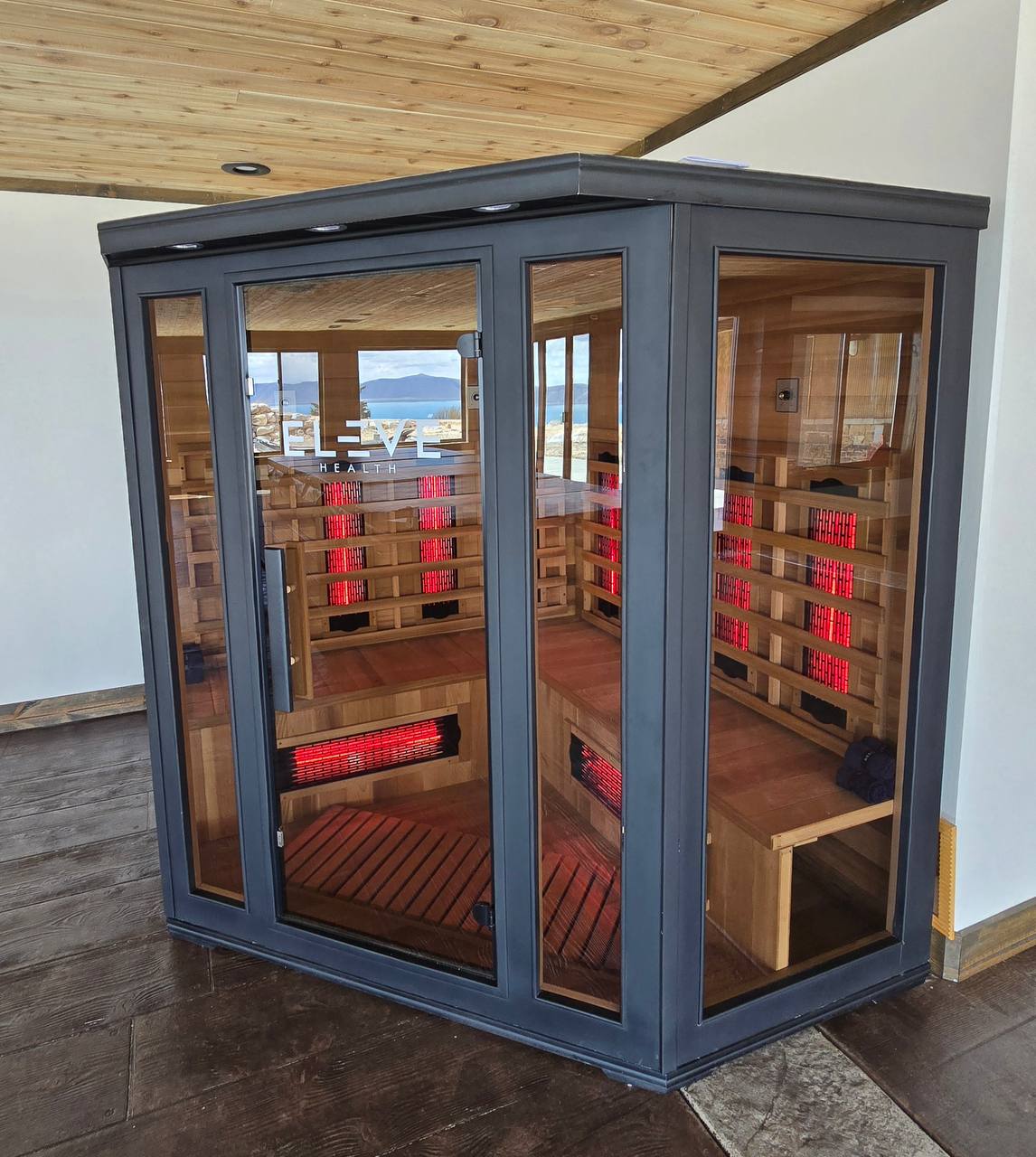

Infrared Sauna
Unlike traditional saunas that heat the air around you, our ELEVE™ Health Infrared Sauna Room uses a combination of advanced near-infrared (NIR) and far-infrared (FIR) heating. The red light (≈650 nm) and NIR (≈850 nm) deliver photobiomodulation while FIR provides deep, non-visible radiant heat to deeply penetrate your skin, raising your core temperature from the inside out for warming and sweating. This allows for a deeper, more effective sweat at a more comfortable temperature to promote detoxification, improved circulation and overall wellness. It creates a comfortable, dry environment for relaxation and is a favorite among athletes for their recovery benefits and among wellness enthusiasts. Our cedar-paneled sauna seats up to 4 people and features stunning lake views through large glass windows — making every session feel like an escape.
Benefits of Infrared Sauna:
Infrared saunas produce the same infrared heat produced by the sun and Infrared heat is required for all living things for optimum health. This radiant heat increases the thermal energy in joints, muscles and tissues. When used as intended as part of a healthy lifestyle, infrared saunas may help living well with certain chronic diseases or conditions.
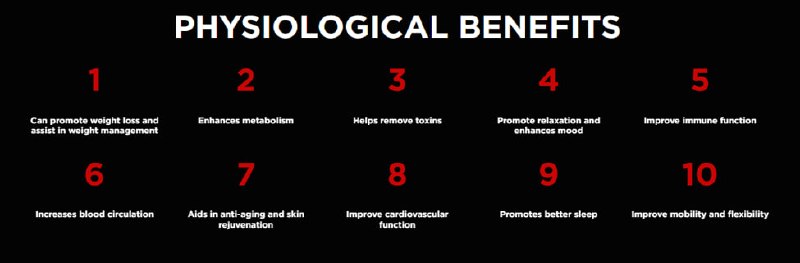
What to Expect
Main Benefits Comparison
Main Benefits:
| Benefit | Steam Sauna | Red Light Sauna |
|---|---|---|
| Detoxification (sweating) | ✅ Strong sweat response | ✅ Deep tissue sweat, possibly more toxin release |
| Skin health | ✅ Opens pores, improves hydration | ✅ Promotes collagen, reduces inflammation/acne |
| Respiratory health | ✅ Moist air soothes lungs, helps congestion | ⚠️ Not moisture-based, less benefit for airways |
| Muscle recovery / joint pain | ✅ Heat soothes soreness | ✅ Infrared penetrates deeper into muscles/joints |
| Circulation / cardiovascular | ✅ Raises heart rate, mimics mild exercise | ✅ Improves circulation and vascular function |
| Relaxation / stress relief | ✅ High humidity relaxes muscles | ✅ Red light calms nervous system and supports serotonin/melatonin balance |
| Energy & metabolism | ⚠️ Minor boost | ✅ Can increase mitochondrial energy (ATP) production |
| Weight loss support | ⚠️ Water weight loss mostly | ✅ Slightly more metabolic activation via deeper heating |
Ideal For:
| Goal | Best Choice |
|---|---|
| Respiratory or sinus health | Steam Sauna |
| Muscle recovery or chronic pain | Red Light Sauna |
| Skin rejuvenation / anti-aging | Red Light Sauna |
| Relaxation and sweating | Steam Sauna |
| People sensitive to heat | Red Light Sauna (gentler overall) |
In short:
- •Choose Infrared Sauna if you want deeper muscle recovery, skin rejuvenation, anti-inflammatory benefits, cellular repair and long-term health optimization.
- •Choose Steam Sauna if you want hydration, respiratory comfort and traditional relaxation.
- •Using both alternately can give the best overall results (e.g., steam 2×/week, red light 3×/week).
FAQ's
Research Studies
There are over 80,000 chemicals present in the world that were not around when my grandparents were children. Out of those chemicals, less than 1% of them have been tested to determine any long-term detrimental effects on human life.
In 1997, the World Health Organization found that poor environmental quality is responsible for 25% of preventable disease in the world! Physicians for Social Responsibility, an Oregon-based group, states that environmental illness in children alone in the US costs 55 billion dollars a year. Every year we see deadly and debilitating diseases like cancer, diabetes, autoimmune disorders, autism, Parkinson's and Alzheimer's on the rise. How are these noxious chemicals affecting our lives and what can we do about it?
Some harmful toxins, like Bisphenol A (BPA), are put in plastics that are made to hold food! This is scary. Even some of the so-called “non-BPA” plastics will emit harmful chemicals when microwaved. Polychlorinated biphenyl (PCB's) are still being manufactured and DDT and other horrendous pesticides are being spewed out in other countries that are emerging nations with less stringent environmental laws. These and other toxic chemicals have been shown to be endocrine disrupters. They can cause cancer and host of other ailments and diseases. This is an obvious major health concern.
A comprehensive study done by the UN in 2013 found that these endocrine disruptors have the potential to alter the function of our hormonal system, increasing the incidence of breast cancer, prostate cancer, thyroid cancer, neurological and developmental disorders, attention deficit disorder (ADD) and hyperactivity in children. The study went on to say that our present testing methods and understanding of the breadth and effects of these endocrine disrupter chemicals are only “the tip of the iceberg” and that much more work needs to be done to fully understand the sources of these chemicals and the myriad ways that people get exposed.
Toxins have been directly linked to cancer, immune dysfunction, dysregulation of glucose, respiratory problems and cognitive problems (1). Today, 25 million people have diabetes, and cases of Alzheimer's disease has more than doubled since the 1980's. The prevalence of autoimmune diseases (2) over the last two decades has been astounding. Dr. Douglas Kerr, M.D., PhD. at Johns Hopkins School of Medicine makes it perfectly clear: “There is no doubt that autoimmune diseases are on the rise and our increasing environmental exposure to toxins and chemicals is fueling the risk. The research is sound. The conclusions unassailable.”
The endocrine disrupters are bad enough, but it gets worse. Let's explore how these chemicals enter into our ecology and become highly concentrated over time. Lead, mercury, PCB's, dioxin and heavy metals wash into large bodies of water after being spewed into the sky from smokestacks and other points of entry. Toxins settle in the water to be taken in by smaller organisms, such as algae and plankton, which are eaten by small aquatic creatures, then small fish and even larger fish as the toxins move up the food chain. This concentrates the chemical so when we eat the fish it may be 50,000 times greater than what the diluted concentrations of the toxins were when they originally entered the water. This compounds the problem greatly and these chemicals do not easily go away. Mercury used in the 1800's to extract gold in the Sierras is showing up in fish caught in the San Francisco Bay over one hundred and fifty years later! The mercury in these fish are a big health hazard and specific fish should not be eaten. Many of these chemicals are here to stay for a long time. (3)
Just as toxins bio-accumulate in fish and other wildlife, they do not all just harmlessly wash through our bodies. The body can detoxify itself, but when more toxins come in than can be processed by normal methods these chemicals accumulate. This build-up of chemicals is called the “toxic burden.” This is not just restricted to adults. That's a terrible way to start life. Our children deserve more. The problem is so acute that the CDC now regularly tests large groups of people across the country for toxicity. Their Fourth National Report on Human Exposure to Environmental Chemicals showed that the average person in the US has at least 212 chemicals in their body.
References & Studies:
- •Toxins That Threaten Our Brains (1): https://www.theatlantic.com/health/archive/2014/03/the-toxins-that-threaten-our-brains/284466/
- •Autoimmune Diseases (2): https://www.ncbi.nlm.nih.gov/pmc/articles/PMC3114837/
- •Mercury in Water Systems (3): https://pubs.usgs.gov/fs/2000/fs06100/pdf/fs06100.pdf
- •Environmental Health (4): https://www.mdpi.com/1660-4601/19/7/4323
- •CDC National Report on Human Exposure: https://www.cdc.gov/environmental-exposure-report/
- •Information on Toxicity (NRDC): https://www.nrdc.org/issues/toxic-chemicals
- •Overview on Toxins: http://www.precisionnutrition.com/all-about-environmental-toxin
- •Toxins in Sweat Study: https://www.ncbi.nlm.nih.gov/pubmed/21057782
- •Toxins in Sweat Study (2): https://www.ncbi.nlm.nih.gov/pmc/articles/PMC3504417/
- •Post-exercise Recovery: https://www.frontiersin.org/journals/sports-and-active-living/articles/10.3389/fspor.2025.1462901/full
- •Post-exercise Recovery (2): https://pmc.ncbi.nlm.nih.gov/articles/PMC10286597/
- •Rheumatoid Arthritis: https://pubmed.ncbi.nlm.nih.gov/18685882/
- •Insulin Sensitivity: https://pubmed.ncbi.nlm.nih.gov/19203842/
- •Heart Failure: https://www.researchgate.net/publication/327808238_Effects_of_sauna_bath_on_heart_failure_A_systematic_review_and_meta-analysis
- •Chronic Heart Failure: https://www.jacc.org/doi/10.1016/S0735-1097%2801%2901824-1
- •Reduced Cardiovascular Mortality: https://link.springer.com/article/10.1186/s12916-018-1198-0
- •Cardiovascular Function with Exercise: https://journals.physiology.org/doi/full/10.1152/ajpregu.00076.2022